
Understanding social media management fees and what shapes them
Scope, provider type, and content volume all move the price. Here is how to read what you are actually paying for.
Published 9 September 2026Cost guide
Get your practice's social media sorted
See how a done-for-you content service fits a health practice's real needs and budget.
Why the price range is so wide
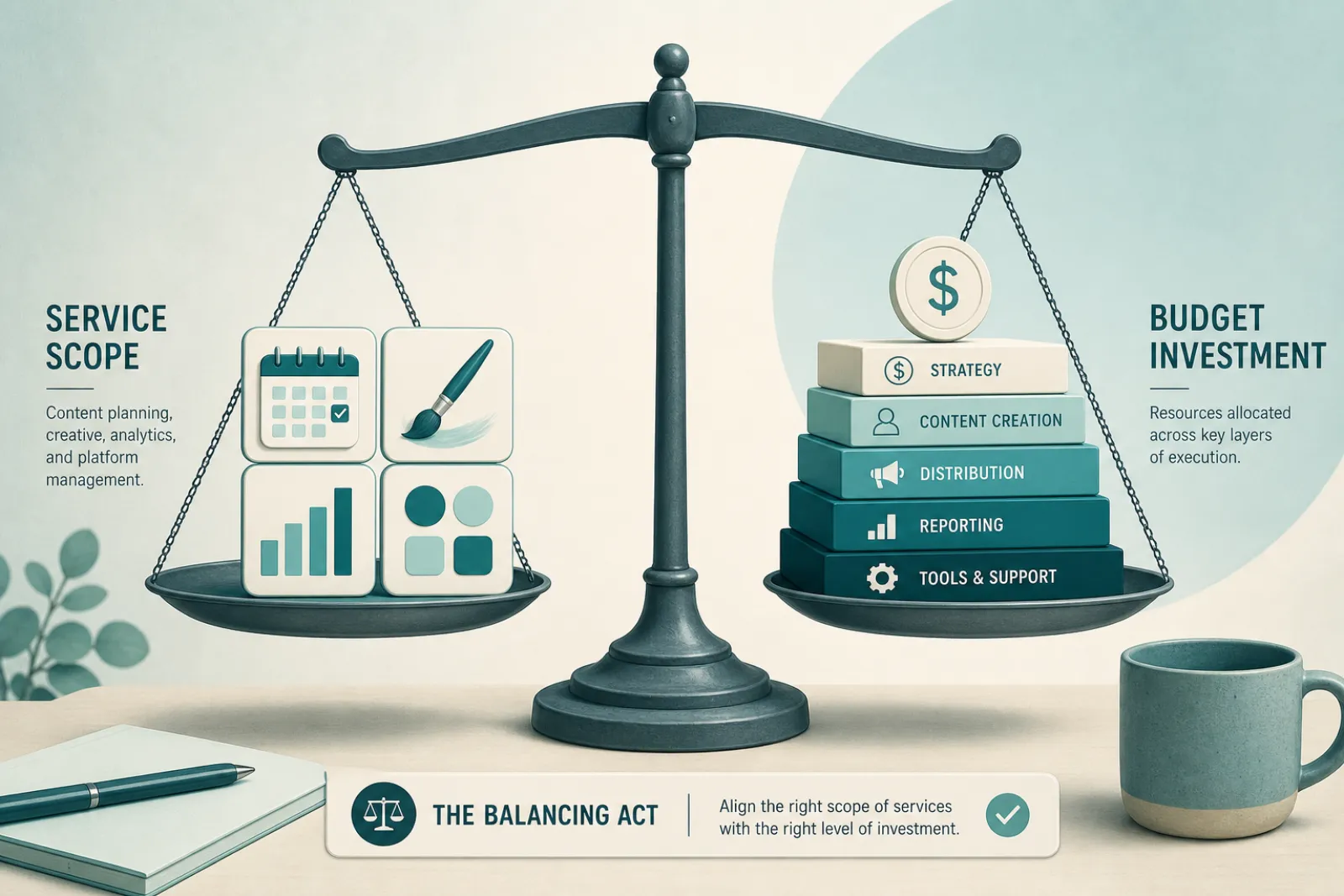
Social media management fees can sit anywhere from a modest monthly retainer to a substantial agency contract, and both figures can be entirely justified depending on what is inside them. The variation is not noise. It reflects genuine differences in scope: how many platforms are covered, how often content is published, whether original creative assets are designed from scratch, and how much strategic planning is baked in. A package that includes content creation, scheduling, community management, paid advertising oversight, and monthly analytics reporting costs more to deliver than one that handles only scheduling and posting. Before comparing quotes, it helps to understand what a full social media management service actually covers so you can read each line item clearly.
The three provider types and what they each bring
Most businesses choose between a freelancer, an agency, or a done-for-you specialist service. Freelancers generally charge lower rates than agencies because their overheads are lower, and they often bill hourly or per project rather than on a fixed retainer. The tradeoff is capacity: a solo operator managing multiple clients may have limits on turnaround time or design quality. Agencies offer team-based delivery, which typically means broader skills under one roof, but their pricing reflects that overhead. Specialist done-for-you services sit in a different category: they are built around a specific type of client (a health practice, for instance) and a defined deliverable, which usually means cleaner pricing and faster onboarding than a full agency. Each model suits a different situation, and choosing the right one depends on how much involvement you want and what outcomes you are trying to achieve.
The cost drivers that move the price most
Platform count is one of the biggest levers. Managing one platform costs less than managing four, because each additional channel multiplies content volume, formatting work, and monitoring time. Posting frequency matters just as much: a service publishing fifteen posts a month requires less production capacity than one publishing daily across multiple accounts. Whether original creative is designed for each post (custom graphics, branded templates, original photography direction) adds meaningful cost compared to text-only or stock-image posts. Strategic planning, including audience research, hashtag strategy, and competitor analysis, is often priced separately or bundled only into higher tiers. Paid advertising management, where it is included, is almost always an additional layer on top of organic content fees, with ad spend itself billed separately again.
Pricing models: retainers, hourly, and project rates
The fixed monthly retainer is the most common model for ongoing social media management, because it gives both sides predictability. You know what you will pay each month; the provider knows what they are delivering. Hourly billing suits one-off projects or consultancy work but can become unpredictable for ongoing content needs. Project-based pricing is common for defined campaigns: a product launch, a seasonal push, or an account audit. For health practices that need consistent, month-to-month presence, a retainer structure is usually the most practical fit. The key question with any retainer is not just the headline figure but what is included, what triggers additional charges, and whether there is a minimum contract length.
What health practices should weigh before deciding
A regulated health practice has considerations that a general business does not. Content about clinical services, treatment outcomes, or patient results carries compliance risk if it is inaccurate or makes implied promises. AI-generated content tools can produce posts quickly and cheaply, but they have no awareness of what is appropriate for a chiropractic clinic or a psychotherapy practice. Human review of every post before it is published is not a luxury for a health practice; it is a basic safeguard. Cost should be weighed against that risk. A cheaper tool that publishes unreviewed content is not necessarily a saving. For context on how a done-for-you service built specifically for health practices approaches this, see how 99 Creative works for dental practices as one example of what specialist delivery looks like in practice.
What drives social media management fees
Each of these factors can move the price significantly. Understanding them helps you compare quotes that look similar on the surface.
Number of platforms
More platforms mean more content, more formatting, and more monitoring. Each additional channel adds to the workload and the fee.
Two platforms costs less than four, even at the same posting frequency.
Posting frequency
Higher post volume requires more production time. A daily posting schedule costs more to deliver than a weekly one.
Frequency is often the clearest lever for adjusting a package price.
Original creative design
Custom-designed graphics and branded visuals cost more to produce than template-based or text-only posts.
Design quality is often what separates entry-level and mid-tier packages.
Strategic planning
Audience research, competitor analysis, and content strategy add time and expertise. These are often bundled only into higher-tier packages.
Entry-level packages frequently exclude strategy work.
Community management
Replying to comments and direct messages requires ongoing attention and is commonly priced as a separate add-on or excluded from base packages.
Always confirm whether this is included before signing.
Paid advertising management
Overseeing paid social campaigns adds a layer of specialist work on top of organic content fees. Ad spend itself is billed separately again.
Ad management is rarely included in starter or basic packages.
Provider type
Agencies carry higher overheads than freelancers, reflected in their fees. Specialist done-for-you services occupy a different position with defined scope and faster onboarding.
The right provider type depends on how much involvement you want.
Contract length
Longer minimum contracts may come with lower monthly rates but reduce flexibility. Month-to-month arrangements offer more freedom at potentially higher per-month cost.
Setup fees can add to the real first-month cost regardless of the retainer figure.
Reporting and analytics
Detailed performance reporting, monthly reviews, and quarterly strategy sessions add time and are often included only in mid-tier and above packages.
Basic packages may offer little or no reporting.
The gap between a low quote and a high one almost always comes down to what is actually included, not what the provider calls the package.
How to work out what you actually need
Audit your current social presence
Before comparing any pricing, look honestly at what your practice's social media looks like right now. How often are you posting? On which platforms? Is the content consistent in tone and design? Knowing your starting point tells you whether you need a light maintenance service or a full rebuild of your content output.
Define the scope you actually need
List the platforms you want covered, the posting frequency you are aiming for, and whether you need original creative design or are happy with template-based content. Decide whether community management (replying to comments and messages) is essential or a nice-to-have. Scope drives price more than almost any other factor, so being specific here saves you from comparing packages that are not equivalent.
Compare what each quote actually includes
Two packages at similar price points can include very different things. One may bundle strategy, design, scheduling, and reporting. Another may cover only scheduling and basic captions. Ask each provider for a line-by-line breakdown. Pay attention to what is excluded: paid ad management, video production, and community management are commonly left out of entry-level packages but easy to assume are included.
Factor in your time, not just the fee
The cost of a service is not only what you pay the provider. It includes the hours you spend briefing them, reviewing content, chasing revisions, and managing the relationship. A lower-cost option that demands significant ongoing input from you may cost more in practice than a slightly higher-cost service with a faster, more self-contained workflow. For health practice owners, that time has a real value.
Check contract terms before committing
Many agency packages require a minimum contract length, often three to six months, with setup fees on top. Freelancers may work month to month but with less certainty of continuity. Understanding the exit terms before you sign matters, especially if your needs change or the content quality does not meet expectations. A month-to-month arrangement with no setup cost is meaningfully different from a locked annual contract, even if the monthly figure looks similar.
Benefits
Scope determines price more than anything
Platform count, posting frequency, creative production, and whether paid ads are included are the primary cost drivers. Matching scope to actual need is the most reliable way to avoid overpaying or under-buying.
Provider type changes the pricing model
Freelancers, agencies, and specialist services each price differently and suit different situations. Understanding what each model delivers (and demands of you) matters as much as the headline fee.
Retainers suit ongoing needs best
For consistent, month-to-month social media presence, a fixed monthly retainer gives predictability on both sides. Hourly and project rates work better for one-off campaigns or audits.
Contract terms are part of the real cost
Minimum contract lengths, setup fees, and exit conditions affect the true cost of a service. A month-to-month arrangement with no lock-in is a meaningfully different commitment than a six-month contract at a similar monthly rate.
Human review matters for health content
For regulated health practices, unreviewed AI-generated content carries compliance and reputational risk that a cheap tool's fee does not offset. Human oversight before publishing is a real cost driver worth paying for.
Use cases
What different fee levels tend to look like in practice
A solo practitioner wanting basic presence
A physiotherapist running a one-person clinic wants posts going out consistently on Facebook and Instagram so the practice does not look quiet to anyone checking before they book. They do not need paid advertising management, video production, or detailed analytics. A basic package covering content creation and scheduling on two platforms fits this need. The priority is consistency over complexity, and the fee reflects that narrower scope. Done-for-you services built for health practices, like 99 Creative's social media management service, are designed precisely for this situation.
A multi-practitioner clinic scaling its marketing
A chiropractic clinic with several practitioners wants to run paid social campaigns alongside organic content, track performance across platforms, and produce video content for reels. This scope requires a provider with design, strategy, and ad management capabilities, which typically means a mid-tier or full-service agency package. The fee is higher because the deliverables are broader, and the practice should expect to invest time in regular strategy calls and briefing sessions.
A practice owner doing it themselves, burning out
Many practice owners start by managing their own social media, then find it becomes the task that gets dropped first when the diary fills up. The real cost here is the inconsistency: a feed that goes quiet for weeks signals to potential patients that the practice may not be active. Switching to a managed service removes that risk. The fee comparison is not just against other providers but against the hidden cost of an unmaintained presence.
A health practice burned by an AI content tool
A podiatry practice tried a low-cost AI automation tool and found the posts were generic, occasionally inaccurate about treatment claims, and visually off-brand. For regulated health practices, content accuracy and brand appropriateness are not optional. The saving on the tool's fee was offset by the time spent correcting posts and the reputational risk of content going out unreviewed. This is why human review before publishing is a meaningful differentiator, not just a marketing claim.
FAQ
Social media management fees: common questions answered
The biggest drivers are the number of platforms managed, how frequently content is published, whether original creative assets are designed for each post, and whether services like paid advertising management, community management, and analytics reporting are included. Provider type also matters: agencies carry higher overheads than freelancers, which is reflected in their pricing. The more of these elements a package includes, the higher the fee.
For ongoing, consistent social media presence, a fixed monthly retainer is usually more practical than hourly billing. It gives you predictable costs and a defined output each month. Hourly rates suit one-off projects, audits, or consultancy work where the scope is genuinely variable. Most businesses with regular posting needs find retainers easier to budget and manage.
Agencies have higher operating costs: teams of designers, strategists, account managers, and copywriters, plus tools, reporting infrastructure, and business overhead. That team-based model can deliver broader capability, but it is priced accordingly. Freelancers have lower overheads and often offer more personal service, but a solo operator may have limits on capacity, turnaround speed, or design quality compared to a full agency team.
Look carefully at what is included and what is not: community management, paid ad management, video production, and reporting are often excluded from entry-level packages. Check the minimum contract length and any setup fees, and confirm what the process is if you want to cancel or change scope. Two packages at a similar monthly rate can include very different deliverables, so a line-by-line comparison matters more than the headline figure.
For regulated health practices, the risk with unreviewed AI-generated content is that posts may contain inaccurate treatment claims or language that is inappropriate for a clinical context. Human review before publishing is a meaningful safeguard, not just a premium feature. The lower fee of an automation tool needs to be weighed against the time spent correcting content and the reputational risk of posts going out unchecked.
Sources
- Freelancers generally charge lower ratessproutsocial.com
More Pages